
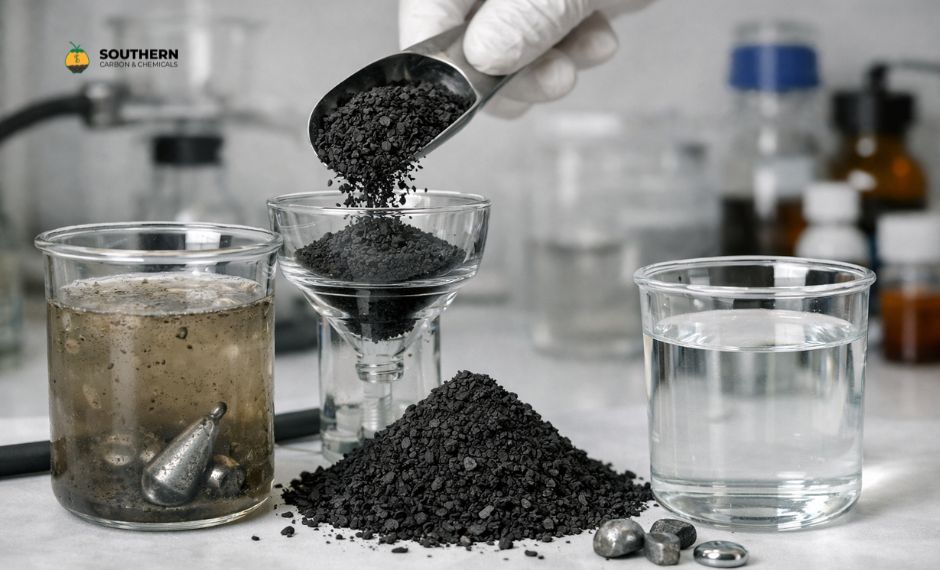
People think that activated carbon can remove all kinds of impurities from water and make it clear; the answer to this is more nuanced. Standard activated carbon is not omnipotent; it has its own limitations when it comes to the filtration of certain chemicals, metals, and microorganisms. Knowing more about the product will give you clearer insight, so you can select the right solution for your filtration processes.
What is Activated Carbon?
It is a highly porous form of carbon with an extraordinary internal surface area. This structure is responsible for the process of adsorption. The contaminant molecules in the water get adsorbed to the surface instead of getting absorbed, making them more effective, relative to other products and processes.
Can Activated Carbon Remove Heavy Metals?
Basically, it depends on the type of activated carbon used.
Standard activated carbon has limitations when it comes to the adsorption of dissolved heavy metals like lead and mercury in their ionic form. The main reason behind this is the size and electrical properties of the metal ions, the ions are relatively smaller and carry electric charges, which makes the process of adsorption more difficult.
Standard activated carbon is effective against organic contaminants. For heavy metals in their dissolved ionic form, impregnated or chemically treated activated carbon is preferred as the ideal solution.
Role of Impregnated Activated Carbon
Impregnated active carbon is standard activated carbon that is chemically treated or impregnated with certain chemical compounds to modify it, so that it can capture particular heavy metals. It is impregnated with different compounds to make it suitable for adsorbing different kinds of metals. This is where activated carbon becomes more powerful.
Types of Impregnation – Removal of Mercury
1. Sulphur Impregnation – Targets mercury removal. Sulphur reacts with mercury vapor and dissolved mercury and binds it permanently with the carbon matrix.
2. Iodine Impregnation – Mercury at lower concentrations is captured using this method, commonly used in industrial air & gas purification systems.
3. Potassium Iodide & Potassium Permanganate Impregnation – Used in special applications to remove mercury from gas streams.
Southern carbon’s activated carbon manufacturers in kerala deals with impregnated carbon according to the demands for – water treatment plants, industrial facilities and gas purification systems.
How Activated Carbon Responds to Different Metals?
| Heavy Metal | Activated Carbon (Efficiency) | Impregnated Carbon (Efficiency) | Inference |
| Mercury | Moderate | Highly effective | Sulphur-impregnated carbon is the industry standard for mercury removal |
| Lead | Low – Moderate | Effective | pH and carbon grade affect the filtration process |
| Arsenic | Limited | Effective | Iron impregnated is preferred |
| Cadmium | Moderate | Effective | Effective when combined with other treatment steps |
| Gold & Silver | Effective | Highly effective | Metal recovery using activated carbon is well established |
Removal of Lead
Lead contamination is a problem that should be given importance, especially in older infrastructure where lead (pb) pipes are still used. Standard granular activated carbon(GAC) can remove trace amounts of lead, but it varies according to the water pH, contact time, and the physical form of the lead present.
Lead that has formed particulate matter or colloidal suspension could be removed by carbon filtration to a greater extent, but when it is fully dissolved in the water, it demands a specialized carbon medium or a multi-stage process for its effective removal from the water.
For treating water utilized for drinking purposes with lead contamination risk, a certified NSF/ANSI 53 – rated filter using high-grade activated carbon, ideally coconut shell-based for its superior quality and micropore structure is recommended for a complete treatment system.
Why Coconut Shell Activated Carbon Stands Out?
Not all activated carbon is equal; the raw material involved in the production really matters. Southern Carbons flagship product – Coconut shell activated carbon has a denser micro pore structure relative to wood-based or coal-based alternatives, which increases the internal surface area, thereby increasing the adsorption capacity. This makes it particularly suited for:
- Drinking water purification where fine contaminant capture is critical
- Point-of-use filtration systems requiring consistent, reliable performance
- Applications demanding a higher activity level
- Industrial water treatment where long carbon life reduces operational costs
As Kerala is a rich source of coconuts, Southern Carbon gains a natural advantage in sourcing raw materials. Access to one of the finest raw materials for carbon production serves as a reason for Southern Carbon being one of the best activated carbon companies in India, among the rest.
When to Use Activated Carbon in Heavy Metal Removal
- Use activated carbon as a first stage to remove the common contaminants, chlorine and particulates, thereby increasing the overall water quality.
- Use Impregnated Activated Carbon for removing targeted heavy metals like lead, mercury and arsenic – in water and gas treatment systems.
- Multi-stage treatments is preferred for heavy dissolved metal ions that require a complex filtration. Activated carbon works best along with an ion exchange system, reverse osmosis treatments and coagulation processes.
So on and so forth, activated carbon is not a universal solution in the filtration of all kind of heavy metals, it becomes effective, if and only if the right product is chosen For mercury, sulphur-impregnated carbon or iodine impregnated works the best. For lead, coconut shell activated carbon coupled with other treatment procedures will do the work.
At Southern Carbon, with over 23 years of experience in the activated carbon industry, we help clients across water treatment, industrial processing, and environmental sectors find the right carbon solution for their specific needs — whether that’s our standard coconut shell activated carbon, impregnated grades, or pelletized forms engineered for demanding applications.
Understanding the limitations and strength of different type of activated carbon is the first step towards creating cleaner and safer air and water.