
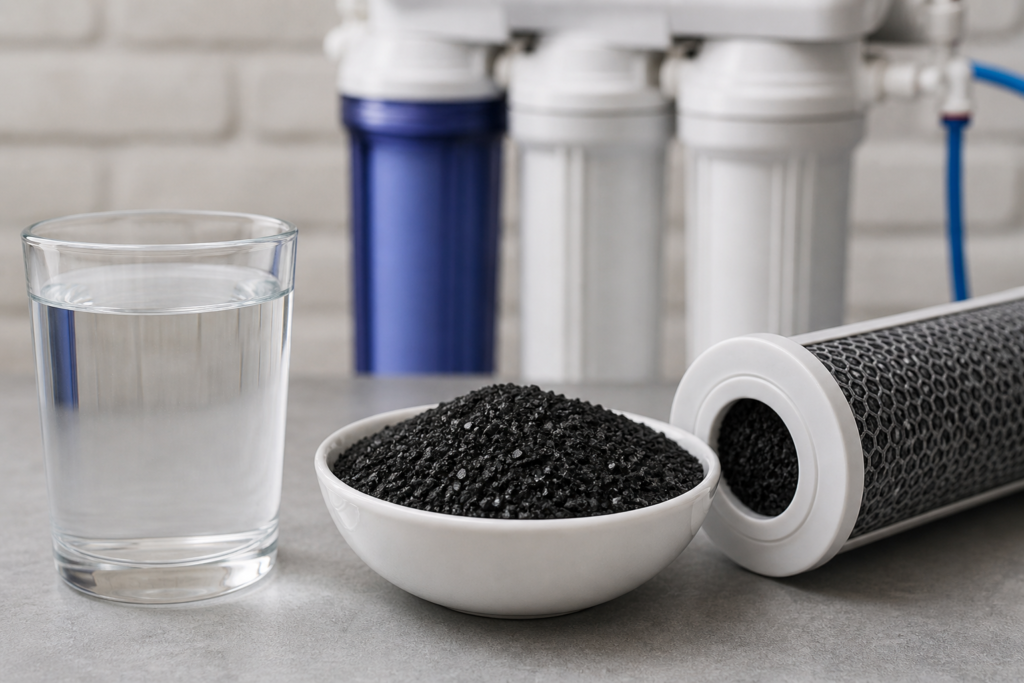
Most people use a water filter every day without really thinking about what is going on inside it. It could be a small jug in the fridge or a full industrial system running in a factory. Either way, the core material is usually the same – activated carbon. And that brings up the obvious question. Why this material? What does “activated” even actually mean in practical terms? If you’re trying to understand water purification properly, this is where it starts.
What is Activated Carbon?
Activated carbon is basically charcoal that has been processed in a controlled way so that it becomes extremely porous. Manufacturers start with raw materials like coconut shells, coal, or wood. These are heated at very high temperatures. During this process, volatile compounds are driven out, and a network of pores starts forming inside the structure.
What you end up with is not just carbon, but a highly porous carbon structure with a huge internal surface area. Most of it is hidden inside those pores. And the scale is honestly hard to imagine. Just one gram can have over 1,000 square metres of internal surface area available for trapping contaminants.
How It Works: Adsorption (Not Absorption)
People mix these two up all the time, so it’s worth being clear. Absorption is when something gets soaked inside a material, like water in a sponge. Adsorption is different. Here, particles don’t go inside the material – they stick to the surface.
In a water filter, that’s exactly what happens. As water passes through, contaminants get attached to the surface of the carbon and stay trapped in the pores. Clean water continues flowing through the system.
The Real Benefits of Water Filtration
1. Fixing Taste and Odour (Chlorine)
If your tap water smells like a swimming pool, that’s usually chlorine. It’s added on purpose to kill bacteria, which is necessary, but it leaves a strong taste and smell behind.
Activated carbon helps reduce that. It reacts with chlorine and brings the levels down, which improves both taste and odour noticeably.
2. Stopping Organic Pollutants
Water doesn’t just contain minerals; it can also carry pesticides, herbicides, and industrial waste, depending on the source. These are organic compounds, and a lot of them naturally tend to interact with activated carbon. As water moves through the filter, especially when the flow is slow enough, these contaminants gradually stick to the carbon surface and get pulled out of the water stream.
It doesn’t happen instantly, and it’s not something magical either. It really comes down to having enough contact time between the water and the carbon.
3. Protecting Your Equipment
In industrial systems, activated carbon isn’t only about drinking water. Take Reverse Osmosis (RO) systems, for example. Chlorine is one of the biggest threats to RO membranes. Over time, it damages them and reduces efficiency.
A carbon filter placed before the RO unit helps remove chlorine early, which protects the membrane and reduces breakdowns. Less damage, fewer replacements.
4. Improved Clarity
Sometimes water looks slightly dull, yellowish, or cloudy. That usually comes from organic matter or tannins. Activated carbon helps clean that up by removing those compounds and improving the visual clarity of the water.
Common Uses of Activated Carbon Filters
You’ll find activated carbon in far more places than just kitchen filters:
Residential Use: Under-sink filters, countertop units, and fridge systems.
Aquariums: Help keep water cleaner and reduce chemical buildup.
Industrial Plants: Used wherever high-purity water is needed, including electronics and pharmaceutical production.
Wastewater Treatment: Used as a final polishing step before treated water is released or reused.
Why Quality Matters
This is where most people underestimate things. Not all activated carbon behaves the same. It really comes down to the raw material and the way it is processed.
For drinking water, coconut shell activated carbon is usually preferred. It’s not random; it has a dense microporous structure, and those tiny pores are good at catching small organic molecules in water. In industrial use, though, the situation changes. Consistency suddenly becomes a bigger deal than anything else.
You’ll find many activated carbon companies in usa, but the performance isn’t always the same across the board. Some batches work well, some don’t, depending on how tightly controlled the production process is. Because of that, engineers tend to rely on established activated carbon manufacturers in usa or experienced global suppliers like Southern Carbon when they need stable adsorption performance in large systems.
Choosing the Right Manufacturer
For larger projects, selecting a supplier isn’t just about price. Most buyers looking for activated carbon manufacturers in usa usually need technical support as well – things like correct mesh size, iodine value, and activity level based on real water conditions.
One key factor is Empty Bed Contact Time (EBCT). It basically defines how long water needs to stay in contact with carbon for proper treatment. If that’s wrong, performance drops quickly. So, supplier choice directly affects system efficiency.
Conclusion
Activated carbon shows up in water filtration mainly because it simply works when it’s set up properly. It handles contaminants through adsorption and brings down chlorine along with a range of organic compounds in water. You’ll see it used everywhere -from basic home filters to large industrial treatment systems because the behavior is consistent across different setups.
When selected properly and matched with the right system design, it remains one of the most dependable filtration materials in use today.