
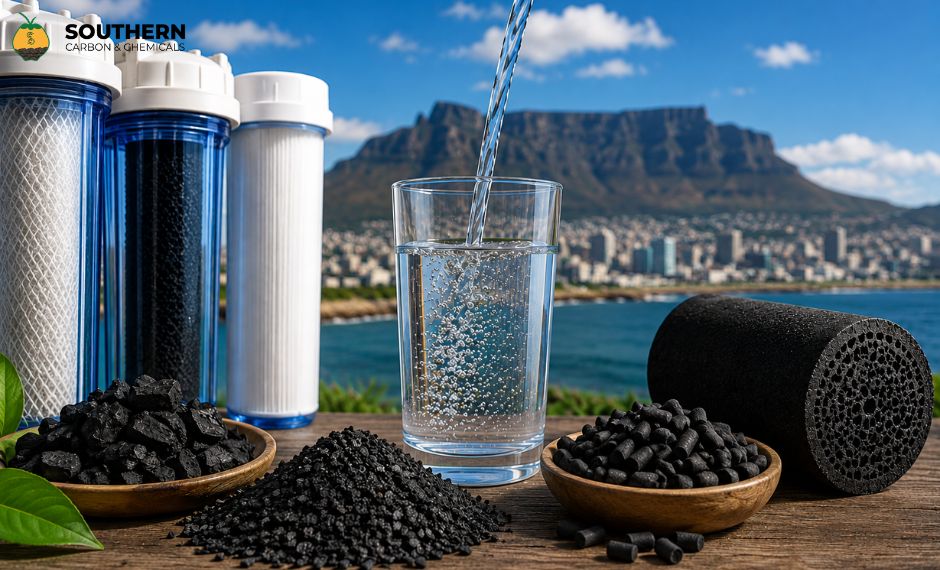
Owing to the growing demand for pure water in South Africa, the employment of activated carbon filtration technology in improving water quality has become an important aspect. The relevance of such technology can be seen in all parts of the country due to varying water quality issues that exist in different areas, such as municipal issues in Gauteng, hard borehole water in Karoo, and organic water in the Western Cape. The only way to ensure the purity of water is by using reliable activated carbon materials.
The choice of activated carbon medium is extremely important. Deciding which type of activated carbon will be chosen- coal, wood, or more environment-friendly coconut-shell or macadamia nutshell activated carbon-is crucial to achieving proper filtration results. Each type of activated carbon has its own unique pore structure and therefore targets different types of contaminants such as volatile organic compounds (VOCs), chlorine, and even humic acids affecting taste.
Which type of carbon medium should one choose for maximum efficiency and longest lifespan? You will get an idea about it through this blog.
Granular Vs Powdered, The Best?
In the case of most water purification plants in South Africa, Granular Activated Carbon is used (GAC) in the form of fixed bed or pressure filters. GAC is suitable for continuous flow processes, provides backwashing capabilities, and, on some occasions, can be recycled for reuse.
Powdered Activated Carbon (PAC) is used in various scenarios, where it is simply put into water and then filtered out via sedimentation or filtration processes. PAC is especially good at coping with sporadic contamination incidents. For example, it will cope effectively with periodic pollution due to algal blooms common in South Africa. For the vast majority of fixed municipal or industrial installations, GAC will be enough. PAC is primarily used reactively.
Coconut shell Activated Carbon – The Safest & Most Recommended Choice
For water purification purposes, coconut shell activated carbon is considered as the ideal product. This type of carbon is microporous, which implies that the pores in this carbon are extremely tiny. As a result, this particular form of carbon will effectively remove contaminants like chlorine, chloramine, VOCs, and those that cause bad tastes and odours.
It should be remembered that these contaminants are quite frequent in South African municipal water supply. Coconut shell activated carbon is much harder than other types such as wood carbon. Therefore, when used, this hard carbon does not create dust and fines, and it is able to retain its structure throughout several backwashing operations, and does not create particle-related problems. Coconut shell activated carbon works well for point of use filters, household filtration, and municipal polish filtration. Furthermore, it is a standard filter media for beverages, including alcoholic beverages.
Why Coal Based Carbon?
Coal-based activated carbon exhibits wider distribution in pores sizes, making it a better choice when dealing with heavy or mixed compounds in industries in liquid form. Wastewater treatment plants and any other application requiring color removal prefer coal-based carbon due to its ability to filter larger organic compounds by its mesopores.
It is softer compared to coconut shell-based activated carbon. Nevertheless, when used in the correct application – especially industrial scale filters where the properties of the source are well understood – it is highly competitive.
The Role of Wood Based Carbon
The wood-based carbon contains the highest percentage of mesopore structure; this makes it efficient in decolorizing operations, adsorbing organic materials with high molecular weight, and also for operations such as sugar refining or beverages processing. With regard to general water filtration, it is not common. Its lower hardness level results in more production of fines.
The Technical Specifications that Matter
While using activated carbon as a filter medium for water in South Africa, the first metric people consider is the iodine number. This indicates, roughly, the amount of microporosity and general adsorption capability. The higher the number, the better the performance for smaller molecules. But, the iodine number does not really reveal anything useful concerning performance of the material against the actual compounds of concern. The same applies to hardness and resistance to attrition. Activated carbon that is prone to breaking down too easily leads to formation of fines which causes increased pressure drop and loss of media longevity.
Finally, ash content, moisture content, and particle size distribution all play critical roles in determining performance once loaded into the system. Ideally, any credible activated carbon supplier should supply the buyer with a detailed Certificate of Analysis of the particular batch. In fact, many reputable activated carbon manufacturers in Kerala provide detailed technical documentation to help buyers verify product quality and consistency. Otherwise, you run the risk of receiving inconsistent batches.
What Does the South Africa Market Needs Right Now?
The water treatment industry in South Africa faces considerable pressure due to the deterioration of the municipal infrastructure and higher levels of organics due to agricultural runoff. Increased regulation governs industrial wastewater discharges. Mining activities are producing wastewater that must be treated to reduce its toxicity before discharging into surface waters.
Under such conditions, the need for quality, high-performing activated carbons will become more acute. In many instances, the best performing carbon does not necessarily have the most impressive specifications, but rather produces reliable performance consistently from batch to batch and in real-world system conditions. Many industries therefore prefer sourcing from established activated carbon companies in India that can demonstrate proven performance and dependable supply. That is what distinguishes a true activated carbon supplier from just another distributor of goods.