
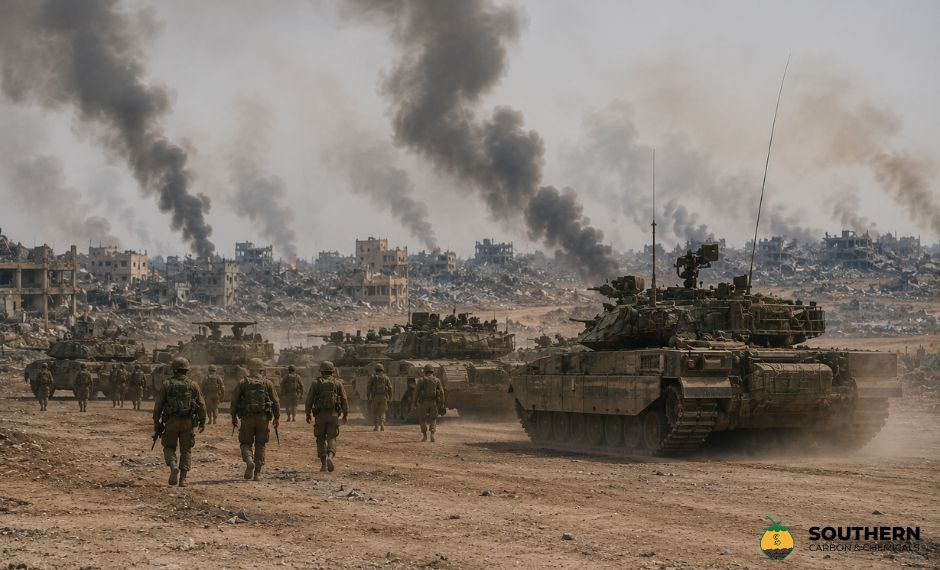
Although international climate change policy is progressing and developing, the ongoing war that exists among numerous nations continuously pulls the process back by taking some steps backward. As nations work on adopting clean energy and increasing their efficiency and decreasing emissions, there are a lot of environmental costs of war associated with burning fuels, fires, destruction of infrastructure, disruption of supply chains, and rebuilding. The true cost of war may be underestimated because not all of the damage done to the environment is reflected in climate reports.
Ukraine’s Emissions Surge
The latest example is the conflict in Ukraine. This proves that the rate at which emissions rise during long-term warfare can be very quick. The studies have found that the war has resulted in nearly 230 million tonnes of CO2e (Carbon Dioxide Equivalent) three years into Russia’s invasion. As the war enters its fourth year, estimates put the number even higher. The emissions from military operations, fires, damage to the energy system, displacements, and carbon costs of rebuilding are all taken into account in these calculations..
Gaza’s Carbon Toll
Gaza War also had its own carbon footprint. Based on some research, the total carbon dioxide equivalents emissions due to the war were nearly 1.9 million tonnes in the initial 15 months of the war. When destruction, clearance of debris, and reconstruction are added, the total would go way above 30 million tonnes of carbon dioxide equivalents. It is pertinent here that there are several layers of carbon emissions that arise from the war. The first layer is obviously the carbon emissions due to the war itself, followed by leakage of fuel, fires, destruction of infrastructure, emergency services, and reconstruction.
Fuel, Fire, and Reconstruction
Combat activities are naturally fuel intensive. Aircrafts, tanks, convoys, generators, naval forces and extensive logistic chains rely heavily on massive amounts of fossil fuels. As the war becomes bigger, more CO2 emissions are produced rapidly since war involves continuous transportation, energy and mobility in harsh conditions.
Moreover, damage is enhanced by destruction. Near-by explosions can affect and destroy such installations as refineries, power plants, pipelines, fuel stations and industrial facilities. The burning of these installations leads to the emission of carbon dioxide, soot, methane and other harmful pollutants into the air. Even after the war is over, leaks and spills might contaminate waters and soil. Moreover, there is another dimension to the environmental price of war – reconstruction. Cement, steel, transportation and heavy equipment are necessary for the restoration of infrastructure. Being carbon intensive, they add additional cost to the climate of the war even after the war has been over.
Environmental Damage Beyond Carbon Emissions
Apart from greenhouse gases, the war also leads to ecological damage. The natural carbon sink such as forests and grassland are destroyed due to explosions, shelling, and other military activities that might trigger forest fires, leaving the land bare without vegetation, making the ecosystem inefficient as a carbon sink for many years or even decades.
Another type of pollution generated due to war is the chemical and industrial pollution, which is more difficult to quantify than just carbon emission. There might be toxins in rivers, water sources, farms, and cities as a result of pollution by destroyed factories, contaminated water treatment plants, and fuels storage tanks. As the result, there is an environmental problem with the pollution of air, soil, and water.
Atmospheric Damages
The emissions emitted at high altitude constitute yet another cause of worry. From recent researches, it is known that rocket launches and other high-altitude emissions have the potential to emit chlorine and black carbon into the stratosphere and have impacts on the issues of global warming and ozone layer composition. This is highly relevant for the case of rocket launches and other upper atmosphere technologies.
Accuracy is essential here. It is the most accurate piece of evidence which is available from the emissions of rockets at high altitude and not from some generalized statements about the impact of all military missiles in the long run.
Why It Goes Uncounted
Military emissions have not been adequately factored into the global climate accounting process. Fuel consumption during the war period, emissions from fires, emergency logistical efforts, damages to infrastructure, and reconstruction are not factored into the inventory. This represents a significant weakness in the process of assessing, comparing, and mitigating climate change impact.
Under counting of military emissions is important because it portrays the wrong picture of progress. When there is war outside, which generates emissions that are not counted under the same accounting framework, and yet a country has reduced its emission in terms of transport and power generation, the war emissions cannot be considered as something separate from the climate.
The Cost of Climate Change Can’t Be Ignored
War blocks the progress in environment, undermines the ecosystems and puts a prolonged carbon footprint that the planet earth cannot afford to ignore anymore. The carbon emissions and other forms of ecological impacts caused by war should be measured more precisely and managed in a more efficient manner if climate targets are to maintain their credibility. This calls for more accurate measurement, more effective protection of key infrastructure and rapid restoration of the environment in case of war, among other things.
With the rising realization of the environmental impact of war, there comes the increasing demand for a thorough cleanup, air purification and water purification. Activated carbon is a very efficient process to eliminate the dangerous pollution, absorb the volatile organic compounds and restore the air and water that got contaminated. In this regard, the activated carbon products offered by companies such as Southern Carbon become increasingly relevant for environmentally conscious businesses.