
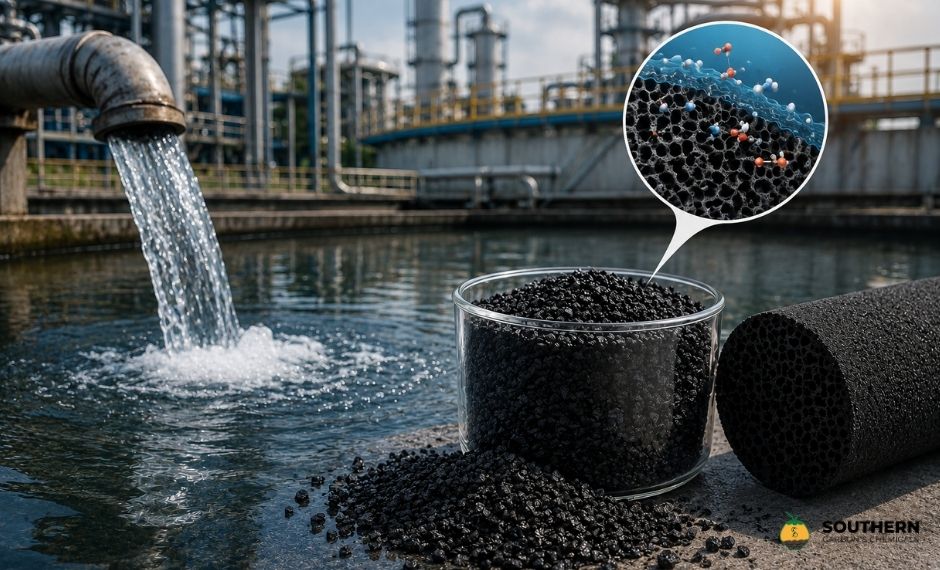
Not all industrial wastewater pollutants can be seen by the naked eye, and some of the most difficult pollutants to eliminate are those dissolved in water. Although most attention is given to suspended solids and heavy metals, dissolved organic pollutants like dyes, solvents, pesticides, and phenols are also among the most problematic ones that are hard to treat. Because they neither settle easily nor undergo effective biological treatment, they remain in water, creating a number of problems in terms of colour, smell, and reuse or discharge of water.
This is where activated carbon comes into play. It is a porous substance and its porous microstructure enables it to adsorb organic molecules from the contaminated water passing through it. The removal is performed through adsorption; granular activated carbon is mostly used for wastewater polishing. At the same time, there is no universal way to apply activated carbon to wastewater treatment. To achieve high efficiency, it is important to select the right type of activated carbon, match its pore structure with the target contaminants, and consider the specific chemistry of the wastewater. When properly selected and applied, activated carbon can provide an effective and reliable solution for removing dissolved organic pollutants from industrial wastewater.
What Makes Activated Carbon Effective for Water Treatment?
Activated carbon is a porous form of carbon that has been processed in order to create a high internal surface area and porous structure. When contaminated water interacts with activated carbon, certain molecules that are dissolved in water become adsorbed onto the surface of the carbon. Performance of activated carbon is determined by its porous structure and surface properties. Since different contaminants have a different interaction with carbon, it is necessary to choose proper carbon types, particle sizes, surface properties and operating conditions depending on the case. Thus, activated carbon is not a universal filtration media and its performance is dependent on the specific use.
According to the US Environmental Protection Agency, granular activated carbon has been successfully applied in advanced water treatment of municipal and industrial wastewaters for removal of relatively small concentrations of soluble organic substances left by other treatments.
Which Organic Contaminants Can Activated Carbon Remove?
The wide adsorption capabilities of activated carbon are one of its principal benefits. Depending on the nature of the contaminant and the system used, activated carbon can be applied for the reduction of compounds including phenols, aromatic solvents, chlorinated solvents, surfactants, organic dyes, pesticides, herbicides, and some fuel compounds. Activated carbon proves beneficial for industries with diverse dissolved organic contaminants in their wastewater. According to EPA technical information, aromatic compounds, phenolics, surfactants, soluble organic dyes, fuels, chlorinated solvents, and various pesticides and herbicides are among contaminants that can be removed through granular activated carbon adsorption.
Not all contaminants can be effectively removed by means of adsorption. The process of adsorption depends on numerous factors including molecular weight, polarity, concentration, pH, temperature, competition between substances and others. Thus, before choosing the appropriate carbon grade or developing an adsorption system, a proper evaluation of the wastewater should be performed.
How Does Activated Carbon Work in Industrial Water Treatment?
Treatment of industrial wastewater may not only depend on removal of particulates. Dissolved organic matter may change the colour, smell, and make the water unfit for discharge or reuse. The use of activated carbon may be very helpful in addressing some of these problems.
Versatility is among the reasons why activated carbon is still an effective medium for water treatment. This versatile material can be used in water treatment plants for many purposes including wastewater polishing, groundwater restoration and purification process of water. Water treatment has been identified as one of the major applications of activated carbon by Southern Carbon, which provides various types of activated carbon including coconut shell, wood based, pelletized and impregnated activated carbon. For businesses looking for activated carbon for water purification in India, selection of the right type of carbon may not only depend on its adsorption capacity. Parameters such as the raw material, iodine number, particle size, hardness, ash, moisture content, porosity and nature of the contaminant must be considered.
Why is Activated Carbon Important For industrial Waste Water Treatment?
Treatment of industrial wastewater may sometimes involve more than just removing suspended particles. The dissolved organic pollutants can influence factors such as color, odor, COD, and the quality of the water for discharge or reuse purposes. The use of activated carbon is an option for removing many of these challenging organic pollutants. Versatility is another reason why activated carbon is still considered a significant treatment medium today. Activated carbon can be used in treatment processes in various applications such as industrial wastewater polishing, groundwater remediation, and process water purification. Southern Carbon also mentions water treatment as one of the applications of activated carbon and offers different forms of activated carbon such as coconut shell, wood-based, pelletized, and impregnated activated carbon.
For companies in search of activated carbon for water purification in India, selecting the appropriate product is not just about selecting activated carbon with the highest adsorption capacity. Some of the factors to consider include raw material, iodine number, particle size, hardness, ash content, moisture, pore distribution, and contaminant of concern.
Choosing the Right Activated Carbon for Industrial Water
There is not one type of activated carbon that will work well in all applications in industrial wastewater treatment. The coconut shell and wood-based activated carbons, for instance, may differ in their pore structure and adsorption capacities. In some cases, the pelletized carbon may be recommended due to its physical properties. The impregnated or specially treated carbon may be made specifically for removing particular contaminants.
In this case, the industrial consumers must consult with knowledgeable and experienced activated carbon suppliers in India and tell them what they want to achieve with the help of this material. They should test the water and, if needed, perform column or pilot tests in order to calculate the carbon usage rate and replacement periods.
Activated Carbon as a Reliable Solution
Activated carbon is essential in modern industrial water treatment due to its ability to absorb many types of dissolved organic pollutants efficiently. The large internal surface area, flexible forms of products, and previous application in industrial wastewater treatment make this treatment method attractive, especially in the case of the use of activated carbon in the right treatment train.
Southern Carbon produces various kinds of activated carbon, including coconut shell, wood, pelletized, and impregnated activated carbon. In industrial water treatment systems, the right activated carbon may become an effective additional protection against dissolved organic contaminants.