
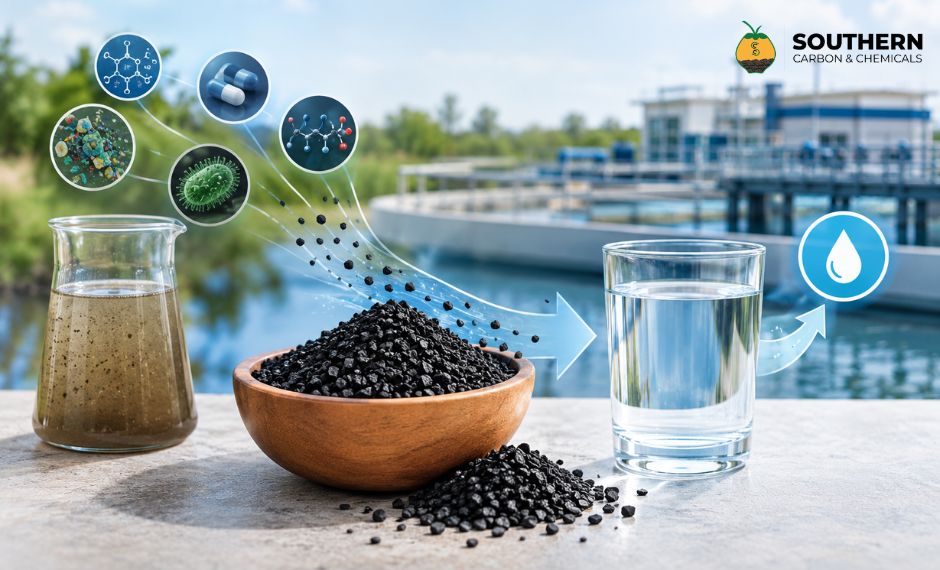
Water can look clean and smell normal while still containing substances that conventional water treatment processes couldn’t fully remove. Since concerns about water pollution grow day by day, activated carbon has become a significant option for treating water that has been chemically contaminated. From pharmaceutical residues to persistent industrial chemicals, activated carbon can play an important role in improving water quality. But how does it work, which contaminants can it target, and what should industries know before choosing a treatment solution?
Understanding Emerging Contaminants in Water
Contaminants are foreign substances (physical, chemical, biological or radiological) that are increasing day by day in water bodies which can harm the environment as well as personal health. These substances include pharmaceutical residues, personal care product ingredients, endocrine disrupting chemicals and per- and polyfluoroalkyl substances (PFAS). Water can be contaminated by pollutants from various sources including wastewater from homes, industrial waste, and agricultural runoff. These chemicals can persist in the environment and may not be entirely eliminated by traditional treatment methods.
According to the “US Environmental Protection Agency (EPA)”, the emerging contaminants possess unique chemical and physical properties so it is important to understand which contaminant is present and how effectively they can be removed.
How Does Activated Carbon Help?
Activated carbon is a highly porous material with a large internal surface area. It is produced by processing carbon rich materials, such as coconut shells and wood, to develop pores that can capture certain substances from water. It works through adsorption, a process in which contaminants attach to the carbon’s internal surface. Activated carbon is widely used to reduce many organic compounds, unwanted tastes and odors and certain chemical pollutants.
The EPA considers activated carbon as one of the treatment technologies studied for removing PFAS from drinking water. However, its effectiveness depends on the carbon type, contaminant properties, water chemistry and contact time. So, it is crucial to choose the right carbon to get effective results.
Which Contaminants Can Activated Carbon Remove?
Pharmaceutical wastes
Waste of Pharmaceutical products like medicines used by humans and animals can cause water pollution if it’s improperly disposed of. Activated carbon can help to reduce certain pharmaceutical wastes through adsorption. However, removal rate may change according to the compound and treatment conditions.
PFAS and persistent industrial chemicals
PFAS are synthetic chemicals used across hundreds of industrial and consumer applications because they can resist heat, water, oil and grease. Some PFAS can prolong for a long time in the environment. According to the “EPA’s research on PFAS treatment”, granular activated carbon can effectively remove certain longer-chain PFAS, including PFOA and PFOS, while shorter-chain PFAS are more difficult to remove. This is why it is important to choose the treatment accordingly because one solution cannot work the same for different pollutants.
Personal care products and organic pollutants
Ingredients from cosmetics, cleaning products and other household products can enter water systems through wastewater. Activated carbon can adsorb many organic compounds, making it useful for treating selected pollutants.
Choosing the Right Type of Activated Carbon
Activated carbon is available in different forms so each of them can fulfill different requirements.
Granular activated carbon contains large pieces of carbon. Water passes through a filter filled with this carbon, removing certain contaminants. This treatment is useful for industrial and drinking water systems.
Powdered activated carbon is a fine carbon powder that is directly added to the water during treatment. After it captures the contaminants, it can be easily separated from the water. The raw materials also matter in this since the coconut shell based and wood based activated carbons contain different porous structure and adsorption characteristics. So, the best choice depends on the target contaminant and water composition. Southern Carbon manufactures coconut shell based, wood based, pelletized and impregnated activated carbon, that offers different options to the customers to choose their treatment needs.
What Should You Consider Before Using Activated Carbon?
Firstly, identifying the target contaminant is important before installing the activated carbon treatment. Testing the water in a lab to identify the water’s as well as the contaminants characteristics is crucial for this.
secondly, test the carbon’s adsorption capacity, the expected water flow rate and the contact time required. Other organic matter in the water may reduce the carbon’s capacity by targeting the adsorption points. It is also important to do proper care for the used activated carbon. By time, it fills with contaminants and becomes less effective. It should be cleaned regularly and replaced if necessary. Also, it should be disposed of properly since it will contain contaminants.
Sometimes, combining activated carbon with technologies like ion exchange or membrane filtration works best against certain pollutants.
How to find a Reliable Activated Carbon Supplier
Finding the best and trustworthy supplier is not about comparing the price of the product. We should give importance to the product consistency, technical specifications, application knowledge and the ability to meet treatment requirements of the customers.
For organizations exploring activated carbon for water purification in India, they should discuss the target contaminants and operating conditions with the manufacturer.
Southern Carbon has manufactured and supplied activated carbon since 2001, with products made from coconut shells and wood for water treatment and other industrial applications. Businesses evaluating activated carbon suppliers in India can use its product range as a starting point for discussing their technical needs.
Conclusion
Emerging contaminants remain a challenge for water treatment because a single technology cannot remove every pollutant. Activated carbon can help to remove many organic substances and certain long-lasting chemicals when the right kind of carbon is used. With proper testing, regular checks and proper maintenance, activated carbon can help make water treatment more effective.