
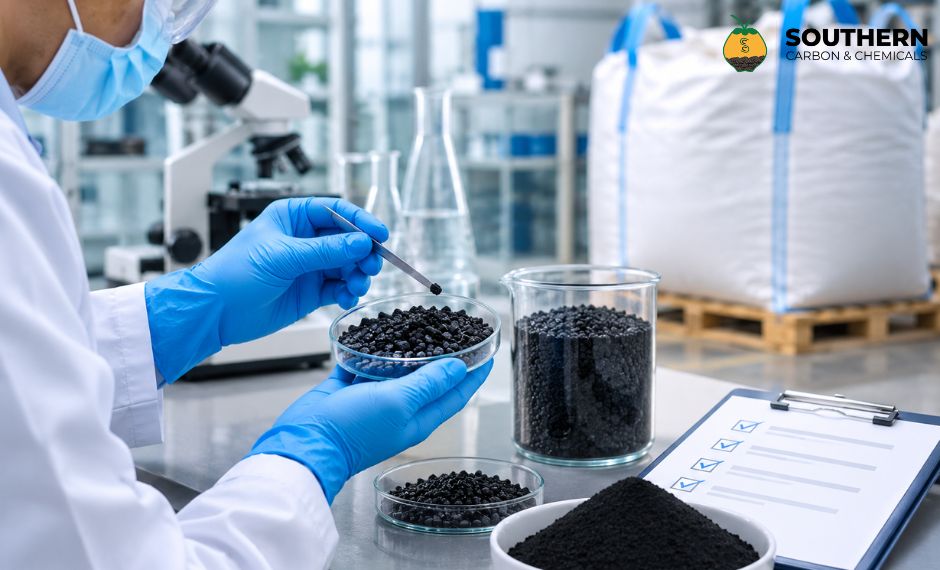
Imagine you’ve waited 6 weeks for your 20 tons of carbon to arrive. You open the bags to find the carbon, but it looks a bit dusty and feels a bit damp. You’re not exactly sure if that’s normal. The data sheet says shows the correct numbers, but your sample 3 months ago indicated something different. The filter bed is due to have its recharge on Monday. This is a stressful situation but it can be avoided almost every time if you had done some basic testing before buying from activated carbon manufacturers in India.
As a buyer you need to be confident with 3 key pieces of information.
1. Information about the tests that were carried out
2. The testing standards
3. Make sure the test is conducted on the same batch which you have chosen
Why Bulk Orders Matter
If a small order of 1 or 2 kg is of poor quality, it can be neglected. But 20 tones being off from the required quality means you’re going to have a poor performing filter bed, your plant will be down and it leads to a monetary loss that you never assumed of. Going for the cheapest price per Kg can be a trap. Often a cheaper carbon will have a lower iodine number and a few more points of moisture mean it will cost more per tonne of working carbon.
Things to Consider
Ask for a report that includes the following. Iodine number (ASTM D4607) is usually the first thing people look at. It indicates how much adsorption capacity the carbon has in its smallest pores. Second one is hardness (ASTM D3802), it tells you how hard the granules are and if they will withstand backwashing without breaking down to dust. Third one is Apparent density (ASTM D2854), it tells you how much carbon fits in your vessel.
Moisture (ASTM D2867), As you’re paying by weight any extra % of moisture means less carbon. Ash content (ASTM D2866), If you’re using carbon anywhere near food, drink or pharma this is the one to watch. Particle size distribution (ASTM D2862), it will tell you how much pressure drop you’ll get and how well it will flow through your system. If you’re using the carbon in the gas phase then CTC activity (ASTM D3467) is also important.
Reading & Understanding the Certificate
A data sheet will tell you what the product is meant to be, that is, its qualities and drawbacks. The certificate of analysis will tell you what the particular batch actually is. Ensure the batch number on the certificate matches what is on your bags. Ask for a few certificates from previous batches. If the iodine values and/or moisture levels vary between batches then you’ll have gained an insight into the consistency of your batches, look for another supplier if the problems recur.
Test it Yourself
Any serious supplier will be happy for you to do some double checking. Ask them to send you a sample from their production batch. This should be sealed and labelled. Send it to your own testing facility or an independent lab. Before confirming your order, write down your requirements. What is the minimum iodine number you require? What is the maximum moisture? What size range do you expect? Decide what you want to happen if the batch you receive doesn’t meet your requirements. This could be a re-test at a neutral lab, replacement or change in price.
Many people will use an independent inspector on larger orders to witness the sampling and loading. Keep a sample from the same batch, so if there is any dispute months down the line you can refer to the evidence.
The forgotten factor
Carbon will absorb moisture from humid air. After weeks at sea there will be plenty of opportunity for this to happen. Ask how the bags are lined and sealed. Are they checking for moisture at the point of packing? If the carbon was perfect in the lab at the factory but has been absorbing moisture for straight 3 weeks in a container, then the initial tests go void.
What do the best exporters do?
The best activated carbon exporters in India will proactively send you test reports. They’ll tell you what standards they’ve tested to. They’ll be happy for you to use a third party.
We’ve been doing this since 2001. As one of the leading activated carbon manufacturers in India, we do everything from sourcing the coconut shells in Kerala to packing for export. Every batch is tested for iodine value, hardness, ash, moisture and particle size. We hold all our samples to the same internal standards whether it’s a sample order or bulk order. So, what you approve will be what arrives at your plant. We assure complete transparency, no stuff in between.
If you’re planning on ordering in bulk, send us your application and specifications. We can brief about the testing process with you and will have a proposal back to you within 24 hours.