
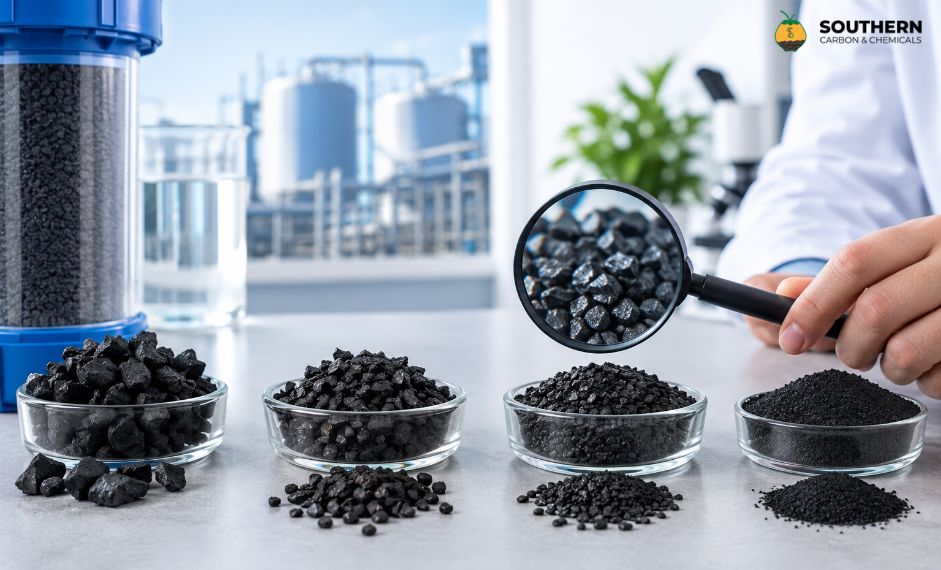
Why would one system containing activated carbon perform better than another system, even though both systems contain high-quality carbon? The answer to this question isn’t always found in the iodine number, the type of raw material used, or the apparent density. More often than many buyers realize, the deciding factor is particle size. Even the highest quality activated carbon could fail in terms of performance if the wrong grade is selected. Although often overlooked, particle size directly affects adsorption effectiveness, flow performance, pressure drop, and operational cost. If the particles are too coarse, adsorption may be slower. If the particles are too fine, they can increase pressure drop, create handling challenges, and reduce service life. Even a slight change in mesh size can significantly affect system performance.
There is no single optimal particle size. It depends entirely on the type of use, the equipment available, and the objective. Irrespective of whether you are purifying water, purifying air, solvent recovery, or decolorizing, the balance between adsorptive efficiency and fluidity varies with each of these uses. This blog will discuss what is meant by activated carbon particle size and its impact on performance.
What Particle Size Actually Does?
While activated carbon works predominantly by adsorption, the way in which the material is crushed and graded has some bearing on its ability to do so. Most notably, the particle size has no effect on how porous the carbon is, but rather affects how accessible this porosity is to the contaminants in question, and how the finished product behaves in a vessel or bed.
Particle size determines adsorption rate, how much space the bed will take up, the amount of pressure drop across the bed, and by extension, the flow characteristics of the finished system. Finer mesh sizes are quicker to adsorb, but also tend to cause faster clogging in any given vessel and can dramatically increase pressure drop. On the whole, a coarser particle size means a higher flow rate, but at the cost of increased distance to travel before adsorption can occur. This means the ‘best’ particle size is inherently application-specific.
Which Grade to Choose for Your Application?
High-flow liquid systems (water treatment works, etc.): Granular grades in the 8×30 or 12×40 mesh range are standard practice for these systems, as they balance contaminant removal and pressure drop across large beds of carbon, which are necessary for processing such a high volume of liquid per hour.
Air and gas purification: Coarser, more uniform granules (often 4×8 or 4×10 mesh) are standard, as gases need to be able to pass through the bed quickly, and excessive backpressure is undesirable. This particle size allows sufficient contact time without impeding the flow rate.
Decolourisation and food-grade processing: Decolourisation and similar processes tend to use powdered activated carbon (PAC) grades, due to the extremely fine particle size and high external surface area that this provides, which is ideal in a batch process where the mixture is stirred and filtered to remove the carbon.
Precious metal recovery: Specialised applications (such as gold recovery) tend to use a particular granular grade (often coconut shell, 6×12 or 8×16 mesh), due to the balance of mechanical resistance and moderate adsorption rate required by the process. Any attrition in the carbon reduces the surface area available for adsorption, which is detrimental to the efficiency of metal recovery.
Point-of-use and small filtration units: Small scale systems (household) or point-of-use may use a finer granular or extruded grade, due to the shorter contact time available in such systems. The contact time is dictated by the flow rate through the system, which is often slower by default in such systems.
What Happens if you choose the Wrong Grade?
Incorrect grades rarely present their problems immediately – either a bed of too fine mesh will gradually choke itself off as pressure builds, increasing pumping costs, or too coarse mesh will allow contaminants to escape system before being properly adsorbed, increasing carbon replacement costs. While these issues are rarely immediate and obvious, over time they can add up to a significant loss of productivity or increased operating costs.
This is why particle size is an important consideration when specifying an activated carbon grade, and shouldn’t be overlooked in favour of other considerations when comparing similar products.
Talk to the Right Manufacturer
Not all applications are the same, and a given particle size that would be perfectly suited to one process may be ill-adapted to a similar one with subtly different requirements. This is where working with experienced activated carbon companies in India can make a significant difference to the lifetime cost of the product, as the right expert can ask the right questions in order to determine what the application really requires.
Southern Carbon has been manufacturing coconut shell, wood-based and impregnated activated carbon for water treatment, air purification, and metal recovery applications for over two decades. As one of the established activated carbon exporters in India, we had the chance to work with engineers and other professionals from the industry on an ongoing basis, helping them to specify the activated carbon grades best suited to their needs in terms of particle size.
Points to Ponder
Particle size is an important consideration when specifying activated carbon in almost any industry, and should be given careful thought during the process in order to optimise performance and reduce operating costs. Understanding the implications of particle size choices will put you in a much better position to find the activated carbon grade ideal for your application. If you have any questions regarding which grade to choose for your application, it’s always a good idea to discuss the matter with a manufacturer representative.