
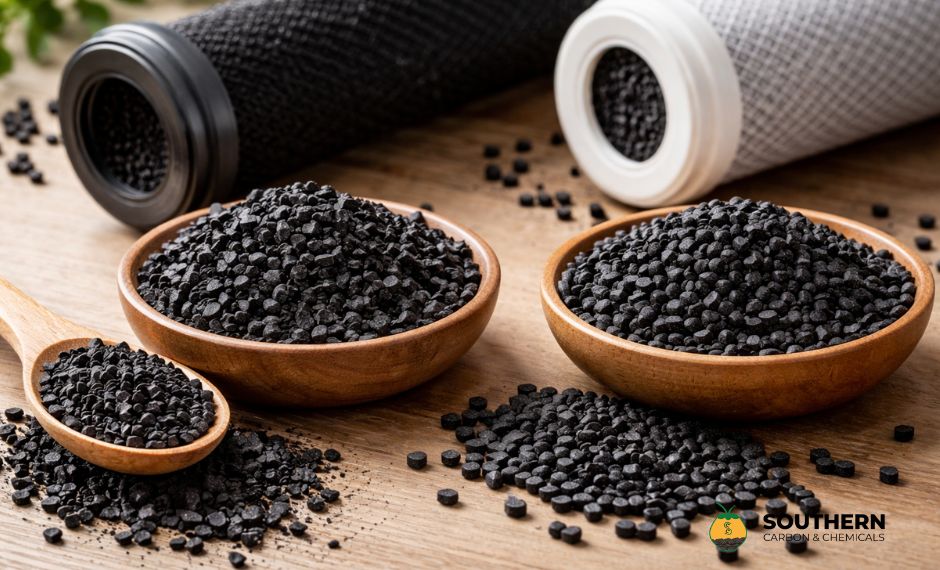
Carbon-based filtration has been a benchmark in purification technology. Carbon filters are used in large-scale public water distribution systems, industrial air scrubbers to filters used in normal households. But, the distinction between activated carbon and regular non-active carbon is often misunderstood – if you choose the wrong product, it will end up in a fiasco.
Southern Carbon, with over 23 years of expertise in manufacturing and exporting premium activated carbon. We are deeply committed to delivering the best quality, reliable product, in a time-bound manner.
What is a Normal Carbon Filter?
A normal carbon filter uses raw carbon, usually powdered or granulated which filters the contaminant mechanically. It effectively traps larger debris, sediments and colloidal suspensions. As the surface area of raw carbon is less it has certain limitations while doing the filtration process. Standard carbon filters are basic, less porous, and interact with those contaminants that could be physically separated from the stream.
What makes Activated Carbon Different?
Activated carbon undergoes a controlled thermal or chemical activation process that transforms its structure. When carbon-rich materials ,such as coconut shells, wood, or coal are treated with high heat or activating agents, millions of tiny pores open up across the surface of each particle. This creates an extraordinarily large internal surface area: a single gram of activated carbon can have a surface area exceeding 1,000 square meters.
This vast porous structure enables activated carbon to work by the principle of adsorption — a process where contaminant molecules are attracted to the carbon’s surface at a molecular level. This is fundamentally different from ordinary filtration. Adsorption allows activated carbon to capture:
• Chlorine, chloramine and disinfection by-products
• Volatile Organic Compounds
• Pesticides, herbicides, and industrial solvents
• Taste compounds, and color-causing agents
• Heavy metal ions (in certain impregnated forms)
Where Activated Carbon Gets the Leading Hand?
The superiority of activated carbon is visible while coming to advanced purification process. Here are the domains where standard carbon filters don’t perform well;
Water Treatment
Municipal water treatment, industrial effluent processing, and drinking water purification all depends heavily on activated carbon to clear out chlorine, micro-pollutants, and pharmaceutical by-products. The high adsorption capacity of the activated carbon makes it safe according to the approved consumption standards, normal carbon filters threshold levels are below that of activated carbon filters.
Air & Gas Purification
In industrial settings, activated carbon filters are utilized to separate volatile organic compounds, hydrogen sulphide, and toxic gas emissions from production lines. The large surface area and heavy micro porous structure is precisely engineered to effectively bind molecules in the gas phase — a nearly impossible task for standard carbon products.
Food, Beverage & Pharmaceutical Industries
Activated carbon is a regulated, approved processing agent used to decolorize liquids, remove specific taste making compounds, and also for purifying ingredients. Food-grade and pharmaceutical-grade applications demand a level of purity that only activated carbon can deliver effectively.
Gold & Precious Metal Recovery
In the mining and metallurgical industries, activated carbon is critical for the carbon-in-pulp (CIP) and carbon-in-leach (CIL) processes. The adsorptive capacity enables the activated carbon structure to effectively and precisely separate gold complexes. A highly specialized process that raw carbon cannot perform.
The Role of Raw Material in Activated Carbon Quality
Not all activated carbon is the same. The material used as the raw material has an important role in deciding its structure, the micro pore network, hardness an adsorptive capacity. At Southern Carbon, we are dealing with coconut shell activated carbon, which is reliable and effective in most of the applications across industries.
Coconut shell carbon produces a dominant microporous structure, making it ideal for the removal of compounds with low molecular weight, volatile organic compounds, and other organic compounds present in trace amount. It is harder, denser, and more durable than carbon derived from wood or coal.
Kerala being the abundant source of coconut, it makes Southern Carbon uniquely positioned to provide a consistent, sustainable raw material stream without any hindrance, thereby converting the raw material into premium activated carbon that meets every requirement. As a trusted, supplier and activated carbon manufacturers in USA, India, Japan, Korea, we are well aware of the existing global demands
Conclusion
When looked upon the performance demands of modern water treatment, air purification, food processing, and industrial applications, activated carbon is superior to standard carbon filters. The activation process unlocks an extraordinary capacity that raw standard carbon can’t match.
The matter is not about choosing between activated carbon or standard carbon, the raw materials and grade of carbon must be aligned with your area of application for drawing maximum results. That is where expert guidance matters. With over two decades of experience supplying activated carbon to industries across the globe, Southern Carbon is equipped to help you for choosing the best products which suits your application. With growing international presence, our company is recognized among trusted activated carbon companies in USA, solidifying our reputation in the global supply chains.
Choosing the right activated carbon is an investment in the quality, safety, and efficiency of your process. Choose wisely.
Activated carbon does not only filter air or water, but it reacts with, or chemically interact with various types of contaminants, binds with the molecules which pass through it with the help of their heavily porous structure to purify, that which cannot be attained by mechanical filtration.