
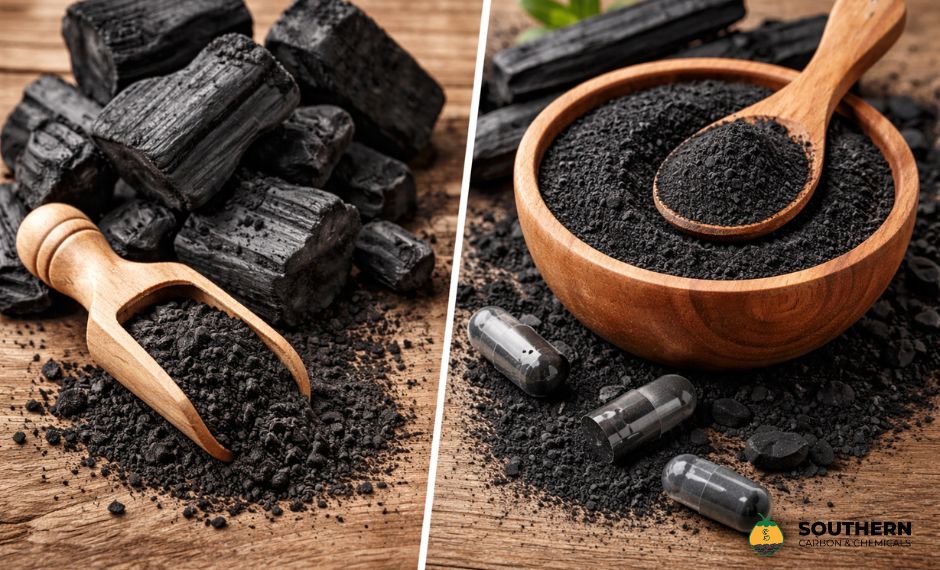
Many people use the words charcoal and activated charcoal as if they mean the same thing. They look identical – just black, messy chunks of carbon. But the difference is actually invisible to the naked eye. Think of regular charcoal as a solid brick; it’s dense and meant for burning. Activated charcoal is the same brick, but blasted with enough heat and steam to create millions of microscopic “tunnels” inside it. For activated carbon companies in the USA, those tunnels are the product. Without them, you aren’t filtering anything – you’re just wasting money on black dust.
What Is Charcoal?
Charcoal is a basic carbon material made by burning natural materials like wood, coconut shells, or peat in low oxygen.
It is:
- Black
- Porous (has holes inside)
- Carbon-rich
Common uses of charcoal:
- Cooking and grilling
- Fuel
- Traditional medicine
- Simple household filtration
- Basic odor control
Charcoal is natural and useful, but it is raw carbon. It has a limited ability to trap chemicals, toxins, or pollutants.
Regular charcoal is fine for a backyard grill, but it simply isn’t built for technical purification. It lacks the internal surface area needed to trap microscopic toxins. To get that level of performance, you have to use activated charcoal- often called activated carbon-which is engineered specifically for heavy-duty filtration.
What Is Activated Charcoal (Activated Carbon)?
Activated charcoal, also called activated carbon, is charcoal that has been specially processed to improve how well it adsorbs impurities. It goes through high heat and controlled treatment, which opens up millions of tiny pores inside the carbon. These tiny pores are what give activated charcoal its strong filtering and purification ability.
It is very effective at trapping and holding:
- Chemicals
- Toxins
- Odors
- Gases
- Impurities
- Contaminants
Simply: Charcoal adsorbs a little, and activated carbon adsorbs a lot.
How They’re Used in Real Life
Charcoal and activated charcoal are used for very different purposes because they serve very different needs.
Charcoal is mainly used for everyday and basic applications like:
- Fuel
- Cooking
- Barbecue
- Simple odor control
- Traditional remedies
- Basic household filters
Activated charcoal, on the other hand, is used in industrial and commercial systems where real purification is required, such as:
- Water purification systems
- Wastewater treatment plants
- Air purification units
- Industrial filtration systems
- Pharmaceutical production
- Food and beverage processing
- Chemical manufacturing
- Gas purification
- Environmental cleanup
- Drinking water treatment plants
This is why industries don’t rely on raw charcoal. They depend on industrial-grade activated carbon because raw charcoal can’t handle real filtration, purification, or treatment demands.
The Practical Value of Activated Carbon in Industry
For industrial operations, choosing activated carbon isn’t about brand preference; it is a matter of operational necessity. Modern production lines and water systems face constant exposure to complex chemicals and pollutants. In these high-pressure environments, filtration is a mandatory safety step rather than an optional upgrade.
Large-scale facilities rely on activated carbon because it provides a reliable solution for:
- Eliminating toxic chemicals and heavy metals from liquid streams.
- Improving water safety and clarity for municipal use.
- Neutralizing toxic industrial gases and persistent odors.
- Protecting Machinery: Getting rid of corrosive materials before they get a chance to circulate and damage costly machinery.
Because of this efficiency, professional projects never include charcoal but rather industrial-grade activated carbon.
Demand Within the US Market
Current trends across the US show a sharp increase in the requirement for cleaner air and safer water. As a result, American industries are transitioning from conventional filtration systems to advanced carbon-based solutions for the following applications:
- Municipal water treatment plants
- Industrial filtration units
- Manufacturing industries
- Environmental protection projects
- Pharmaceutical companies
- Chemical industries
- Food processing units
Due to strict environmental and safety regulations, activated carbon producers in the USA give more importance to:
- Product quality
- Performance standards
- Purification efficiency
- Compliance regulations
- Industrial-grade production
Global Manufacturing and Supply Chains
Not all activated carbon used in the USA is produced locally. Many companies purchase their activated carbon from international manufacturers who specialize in the production of high-quality activated carbon using natural materials such as coconut shells and wood.
While many people search for activated carbon suppliers in the USA, smart procurement managers often look to international experts, such as Southern Carbon, that supply high-hardness coconut shell carbon meeting or exceeding US standards. This provides a logical link.
This global supply model assists industries in gaining access to:
- Consistent quality
- Large-scale production
- Reliable supply
- Cost efficiency
- Sustainable raw materials
Final Thought
If your goal is real purification, real filtration, and real industrial performance, charcoal is not enough. You need activated carbon produced by professional manufacturers and supplied through reliable industrial supply chains.
That’s why industries don’t search for charcoal suppliers. They search for activated carbon companies in the USA and activated carbon manufacturers in the USA, because performance, quality, and reliability matter more than raw material.