
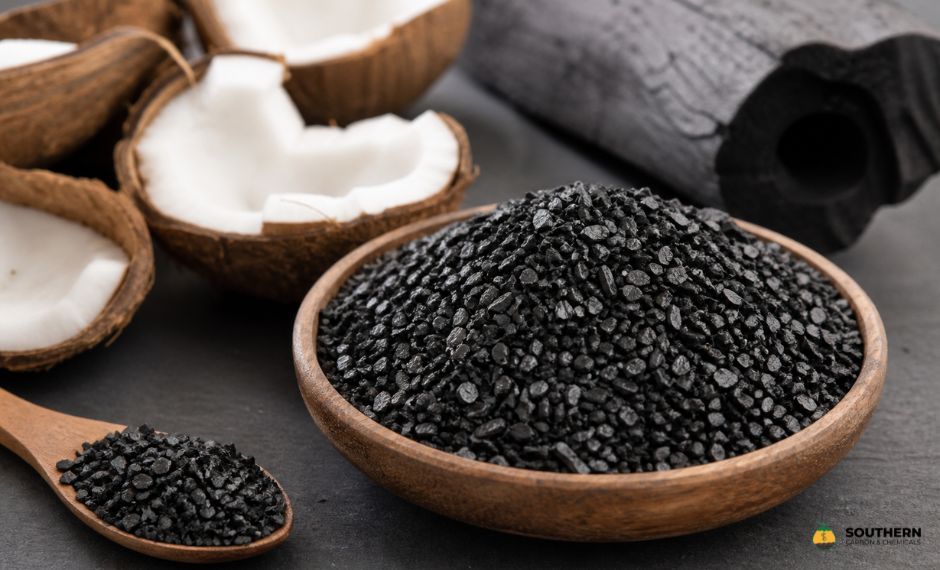
The coconut shell activated carbon price in India can vary a lot from one seller to another. In some cases, you may get a quote near ₹50 per kg, while higher grades and specialized products can go above ₹400 per kg. This can be confusing if you are just trying to budget for a water treatment plant or an industrial process. The reality is that activated carbon isn’t a basic commodity like sugar or salt; it is a precision tool, and you pay for the level of work the carbon can do.
At Southern Carbon, we often explain to our clients that the price per kg is essentially a reflection of the carbon’s internal surface area. The more pores the carbon has to trap impurities, the higher the price will be. In this guide, we will look at what the current market looks like in 2026 and what factors actually move the needle on those costs.
A Realistic Look at the Price Per KG
To give you a straight answer, most industrial buyers in India are looking at a price between ₹120 and ₹190 per kg for a standard, high-quality grade. This is usually the 900 to 1000 Iodine Value (IV) range, which is the workhorse of the industry. It’s what most people use for drinking water filtration or cleaning industrial wastewater.
However, if your needs are very basic perhaps, you are just using it for simple odor control in a large outdoor space, you can find lower-grade carbon for around ₹50 to ₹80 per kg. On the flip side, if you are in a specialized industry like gold mining or pharmaceuticals, you might need a very high-activity carbon with an IV of 1100 or more. These premium grades can cost anywhere between ₹300 and ₹450 per kg. The reason is simple. They need stricter processing, longer activation time, better-quality raw material, and tighter quality control before dispatch.
Why Do Prices Vary So Much Between Suppliers?
If you speak with different activated carbon exporters in India, you will often notice a clear difference in pricing for products that may look similar on paper. In most cases, the gap comes from actual product specifications such as iodine value, hardness, moisture level, ash content, particle size consistency, and overall manufacturing quality.
The biggest factor is the Iodine Value. This is a lab measurement that tells us how much active space is inside the carbon. To get a higher IV, the manufacturer has to leave the raw coconut shells in the steam activation kiln for a longer time. This uses more energy and actually burns off more of the material, meaning it takes more raw coconut shell to make one kg of high-IV carbon than it does for a low-IV version.
Another factor is the physical hardness. Cheap carbon often breaks down into dust very quickly. If you put cheap, soft carbon into a water filter, it will clog your system or leach black dust into your water. High-quality coconut shell carbon is prized globally because it is naturally very hard. It can withstand the high pressure of water flowing through it without crumbling. Paying a bit more per kg often saves you money in the long run because the carbon lasts longer and doesn’t ruin your equipment.
The Role of Raw Materials and Location
The price is also tied to the coconut harvest. Since most of the production happens in South India, in states like Kerala and Tamil Nadu, the local weather and the price of raw coconut shells play a huge role. If there is a shortage of shells, the price of the base char goes up, and the price of the activated carbon follows.
India is currently one of the leading suppliers of activated carbon because our coconut shells are some of the densest in the world. This density is what allows us to create such high-quality microporous carbon that international buyers from the USA and Europe are willing to pay a premium for. When you buy locally in India, you are getting that same export-quality material without the massive international shipping costs, but you are still subject to the global demand that keeps prices competitive.
How to Buy Without Overpaying
The secret to getting a good deal isn’t necessarily finding the lowest price per kg; it’s about not buying more performance than you need. We always suggest that buyers look closely at their specific application. If you are treating water that is already relatively clean, you might not need a 1100 IV carbon. A 900 IV product might do the job perfectly well at a much lower cost.
You should also look at the moisture content. Some suppliers might offer a lower price per kg, but the carbon has a high moisture level. This means you are literally paying for the weight of water. Standard, high-quality carbon should have less than 5% moisture. Always ask for a test report before finalizing a bulk order.
Finally, remember that volume is your friend. Buying a few bags will always be expensive. If you can step up to a metric tonne or a full container load, the price per kg drops significantly because the packaging and logistics costs are spread out over a much larger weight.
Conclusion
The coconut shell activated carbon price in India is a balance of science and market supply. Whether you are looking at ₹120 or ₹400 per kg, make sure you are comparing the same grade and specifications. Check the Iodine Value, the hardness, and the moisture content. By checking these details before you buy, it becomes easier to compare quotes and choose the right material for your application. If you are not sure which grade suits your requirement, it is always better to speak directly with a manufacturer and ask for pricing based on your needed specification and current market rates.