
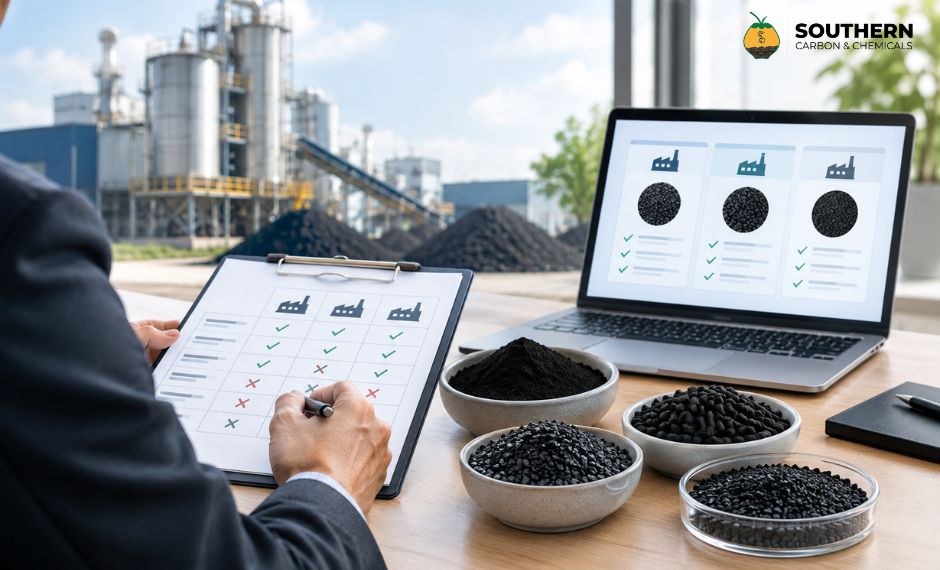
To compare activated carbon manufacturers in India, evaluate them on the following six factors: the origin of the raw material, laboratory reports, batch consistency, customization to your application, shipping and communication efficiency, and contract specifications. Always verify the details through a trial order before investing in a full-scale partnership. A long-term supply contract with a manufacturer works like an employment contract. You are entrusting them with a part of your production process, and it can be costly to terminate the deal and find a new partner.
Comparison Checklist
1. Raw material and source
Raw material determines the application of activated carbon. Coconut shell, wood, coal, peat, etc. produce carbons with a different pore structure. Coconut shell carbon is widely used in water treatment and metal recovery due to its denser structure, while wood based-carbon is suitable for liquid decolourisation. Ask the manufacturers about their preferred source and location. Companies that have experience in the procurement process generally provide more consistent quality.
2. Lab testing and batch reports
Ask for certificate of analysis for the latest few batches and evaluate the following figures:
- Iodine value: an indicator of the adsorption capacity, or the amount of contaminant the carbon can absorb under specific conditions. Basically, higher the value, better the quality.
- Hardness: this is the percentage of granules that can resist crushing into powder under compression. It is an important indicator for any application that requires carbon in granular form.
- Ash content: it shows how much mineral residue is present in the carbon. The lower the percentage, the higher the purity.
- Moisture: it indicates the amount of water in the carbon. This is crucial as higher moisture content means you are paying extra for unwanted material.
- Particle size distribution: the size of individual granules is vital to any water treatment, air purification or gas filtration system.
3. Consistency across batches
A great sample will indicate the quality of the product and not the opposite, so request several batch analysis reports and compare the values to identify the level of variation, if any. The figures should remain in the same direction and ideal range for each indicator. Finally, analyze the sample provided with the first order and compare it to the tested batches.
4. Customization for your application
Water treatment, air purification, gas filtration and metal recovery are basically different processes, so a competent manufacturer will ask about your application, flow rate, contaminants and operating conditions and advise you on the most suitable specification. So, they should be able to modify the particle size, hardness or impregnation to meet your needs.
5. Communication, shipping and documentation
Send them enquiry and pay attention to the tone and speed of the response. Also enquire about delivery terms, packaging options, export documentation and experience in shipping to your country. Communication skills often reflect the company’s attitude towards you as a business partner.
6. Contract terms
The contract should stipulate the following points:
- Acceptable ranges for all indicators specified by the buyer.
- Clarification on what to do in case of an unacceptable deviation.
- Conditions for reviewing the price.
- Delivery timelines and responsibilities in case of delay.
- Payment terms and methods compatible with the payment method.
Signs You Are Talking to the Right Supplier
When shortlisting activated carbon suppliers in India, you will notice that many companies tend to fall into two categories: those that keep clients engaged by sharing reports, asking clarifying questions and being upfront about their limitations, and those that try to push you to a purchase based on some facts and many unsubstantiated claims.
Good signs:
- They can share test reports across all batches on request.
- They ask about your application before recommending a product.
- They are open about the source of the carbon.
- They are not afraid to specify quality indicators in the contract.
- They respond promptly and clearly to all requests.
Warning signs:
- Test reports are difficult to obtain, or every batch has exactly the same figures.
- They promise everything and do not hesitate to push you toward a purchase.
- They cannot provide a detailed overview of the carbon’s origin.
- They are not committed to writing clear terms and conditions for the supply contract.
- They do not reply to your message until you send them another reminder.
A Simple Way to Shortlist
Request samples and test reports from three manufacturers.
- Test the samples in your system for a few weeks.
- Place a small trial order with your preferred manufacturer and move toward a long-term agreement if the sample and trial order meet your quality standards.
- It adds a little time at the beginning of the partnership but is much more cost-effective than trying to find a new supplier after a year of working with the wrong one.
Conclusion
Comparison of activated carbon manufacturers in India should start with asking yourself four simple questions: where is the carbon coming from? is there proof of the claimed quality? Can the desired quality be repeated consistently?, will the manufacturer support my request for information? These four points will help you sort out less honest manufacturers at an early stage, while those that have nothing to hide will welcome the opportunity to share their strengths. At Southern Carbon, we have been manufacturing activated carbon since 2001. We source our coconut shells from Kerala and go through a thorough process of carbonization, activation, grading and laboratory testing before any batch is sent to export. If you are comparing activated carbon manufacturers in India, we are happy to share test reports and samples with you so you can make an informed choice. Contact our team and we will reply within 24 hours.