
Buying activated carbon is easy.
Buying the right activated carbon is where most people get it wrong.
In industrial and commercial applications, “value for money” has very little to do with the lowest price per kilogram. It depends on how long the carbon lasts, how consistently it performs, and how well it matches the actual application. Many buyers realise this only after dealing with frequent replacements, pressure drop issues, or inconsistent results.
For activated carbon exporters in India supplying global markets across Asia, availability is rarely the issue anymore. Problems usually begin when the wrong grade is selected and performance expectations aren’t met in the actual application.
This guide explains how to choose activated carbon logically, based on performance, not assumptions.
Start With the Application, Not the Product
Activated carbon is not a universal solution. Before anything else, it’s important to be clear about where it will be used and how it will be applied.
- Is the requirement for water treatment, or for air and gas purification?
- Is it a continuous flow system or a batch process?
- Are the target contaminants chlorine, VOCs, odour compounds, dyes, or other organic contaminants?
Skipping this step leads to the most common mistake: selecting a high-grade carbon that is technically impressive but practically inefficient for the job.
Raw Material Determines Performance (and Cost Efficiency)
The base material of activated carbon directly affects pore structure and service life.
Coconut shell activated carbon
Being highly microporous and hard, coconut shell carbon is preferred for water purification and gas phase applications where small molecules must be adsorbed effectively. It can be most effective and cheapest in the long run even if it is more expensive initially.
Coal-based activated carbon
A high volume of mesopores (transport pores), coal-based carbon offers superior kinetics. Larger pores help liquids move through the carbon more freely, allowing adsorption to occur more efficiently than in the denser pore structure of coconut shell carbon. This makes it a versatile choice for treating industrial liquids containing a mix of organic contaminants and moderate colour.
Wood-based activated carbon
With a higher mesopore content, wood-based carbon is better suited for heavy decolourisation and applications involving very large organic molecules.
Selecting the wrong raw material often leads to early saturation, which is where most of the cost impact is actually felt.
Granular, Powdered, or Pelletized: Form Matters
The physical form of activated carbon affects system performance and operating cost.
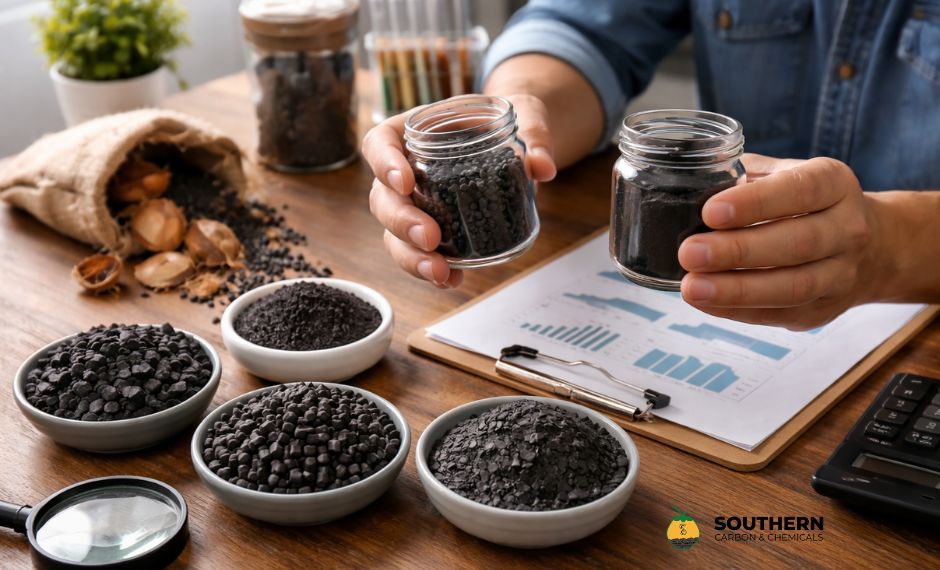
Granular Activated Carbon (GAC)
Commonly used in fixed-bed and column systems. Granular activated carbon offers good contact time, a manageable pressure drop, and relatively easy handling. For this reason, it continues to be widely used in export markets, including industrial filtration systems using granular activated carbon in Korea.
Powdered Activated Carbon (PAC)
Fast adsorption but difficult to recover. Ideal for batch processes or continuous dosing, but typically single-use and not suitable for fixed-bed columns.
Pelletized Activated Carbon
Uniform size, lower dust, and better airflow control are especially useful in gas-phase applications.
Selecting the wrong form can increase maintenance costs even if the carbon itself is inexpensive.
Specifications That Actually Matter
Serious buyers don’t rely on marketing claims. They look at performance indicators. When evaluating activated carbon, a few technical parameters should always be reviewed:
- Iodine number – which indicates micropore content and adsorption capacity for smaller molecules
- Methylene blue value – used to assess performance for larger organic compounds
- BET surface area – meaningful only when considered alongside pore size distribution
- Ash content – since higher ash reduces the amount of active carbon per kilogram and risks leaching impurities
- Moisture content – paying for water weight is a direct loss of value; lower moisture means more active carbon per kilogram
- Hardness or attrition resistance – which affects dust formation and usable life
- Particle Size (Mesh Size) – Determines the pressure drop and filtration rate; wrong sizing leads to system blockages or poor contact time.
The Density Trap: Volume vs. Weight
Most buyers overlook one critical factor: Apparent Density (AD). You buy activated carbon by weight (kg), but you fill your vessels by volume (m³ or liters). A cheaper carbon often has a higher density, meaning you need more kilograms to fill the same vessel compared to a lighter, premium carbon. Buying a “cheaper” heavy carbon often results in a higher total cost to fill your system.
If these values cannot be supplied consistently, comparing prices alone doesn’t provide a reliable basis for selection.
Service Life Is the Real Cost Indicator
The real cost of activated carbon is rarely the purchase price. It depends on how often the replacement of carbon is required.
Low-quality carbon:
- Saturates Faster
- Generates excessive fines and dust
- Causes channelling in packed beds
- Often needs shutdowns
High-quality carbon:
- Keeps adsorption efficiency longer
- Decreases downtime
- Provides consistent performance per batch
This is the reason why seasoned buyers normally source their purchases through activated carbon exporters in India, who give more importance to quality than quantity.
Hidden Costs Buyers Often Ignore
Value for money is lost when buyers ignore:
- Pressure drops increases (often caused by wrong mesh size or soft carbon crushing)
- Dust-related clogging
- Inconsistent batch quality
- Lack of technical support
These factors don’t show up on invoices, but they show up in operating expenses.
Think Long-Term, Not Per Kilogram
The correct approach is simple:
- Match pore structure to contaminant size
- Match form to system design
- Match quality to expected service life
When these align, even a moderately priced activated carbon delivers better value than a cheaper alternative.
Final Perspective
Choosing activated carbon is a performance decision, not just a purchase. The right selection improves system stability, reduces downtime, and lowers long-term operating costs.
This is where experienced suppliers like Southern Carbon add value by focusing on application-specific carbon selection and consistent quality rather than generic grades. For industries sourcing from activated carbon exporters in India and supplying demanding markets such as Korea, informed selection directly affects performance and cost efficiency.