
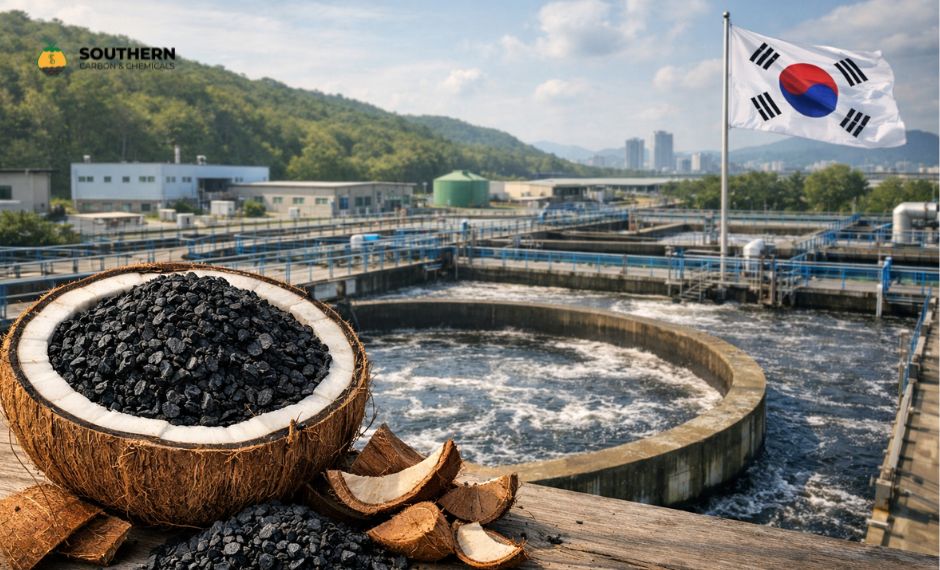
If you look at how wastewater treatment has evolved in Korea over the years, one thing is clear: expectations are higher now. Plants are no longer judged only on whether the water looks clean. Odour, colour, trace organics, and long-term discharge impact all matter.
This has directly increased the demand for activated carbon in Korea, especially in wastewater treatment facilities that deal with industrial discharge or reuse systems. Operators today spend more time evaluating carbon quality than they did earlier, comparing both domestic suppliers and activated carbon manufacturers in Korea, as well as overseas sources. Over time, many plants have leaned toward coconut shell activated carbon not because it’s fashionable, but because it works consistently under real operating conditions.
Wastewater treatment in Korea: what actually makes it difficult
On paper, wastewater treatment looks straightforward. In practice, it rarely is.
Korean treatment plants often handle wastewater with:
- mixed industrial discharge
- varying organic loads
- compounds that don’t break down easily
- strong odours that create local complaints
Space is another issue. Many plants operate in dense urban or industrial zones, which limits expansion and pushes operators to squeeze more performance out of existing systems. Because of this, the final treatment stages carry a lot of pressure. If something goes wrong there, the entire plant output is affected.
Why is activated carbon becoming unavoidable
Activated carbon is usually introduced when other processes reach their limits.
Biological treatment does a lot of the heavy lifting, but it doesn’t remove everything. Chemical treatment helps, but it has limits and side effects. What’s left – dissolved organics, colour, smell – is where activated carbon comes in.
In wastewater systems across Korea, activated carbon is often used as a polishing step. At that stage, failure isn’t an option. Media that degrade quickly or behave inconsistently create more problems than they solve.
That’s why material choice matters.
Not all activated carbon performs the same
This is where a lot of people oversimplify.
Activated carbon can be made from coal, wood, coconut shells, and other raw materials. On paper, many of them look similar. In actual operation, they don’t perform the same way.
Coconut shell activated carbon tends to stand out because:
- it has a pore structure that works well for smaller organic molecules
- it holds up better during repeated backwashing
- it breaks down less over time
- it maintains performance longer in continuous systems
These things don’t always show up immediately. They show up after months of operation, when cheaper carbon starts losing effectiveness.
Why coconut shell activated carbon fits Korean plants better
The preference for coconut shell activated carbon in Korean wastewater treatment plants didn’t happen overnight. It came from trial, comparison, and experience.
Plant operators noticed a few consistent advantages:
- more stable effluent quality
- fewer operational disruptions
- lower carbon loss during handling
- longer intervals between replacements
In systems where compliance margins are tight, stability matters. If a carbon works for only a short time and then starts falling apart, it just makes life harder for the operators. Over the months, people running the plants noticed this and started choosing materials that last longer and don’t cause so many headaches.
Where It Is Used in Wastewater Systems
Coconut shell activated carbon gets used in a few different spots in Korean wastewater plants.
- Tertiary treatment in municipal plants. Sort of the last clean-up before the water goes out.
- Industrial effluent units. Take care of organics that don’t really break down.
- Odour control systems. Keeps smells from spreading.
- Reuse and recycling setups, where water needs to stay consistent.
It works in both fixed-bed and continuous systems, which is why plants keep using it.
How engineers actually judge activated carbon
Purchasing decisions are rarely based on brochures.
Engineers tend to look at:
- adsorption performance indicators like iodine value
- how uniform the carbon particles are
- how much material is lost during the operation
- whether quality stays consistent between batches
- whether technical data matches real performance
This evaluation approach applies across the market, whether the supplier is local or part of the wider network of activated carbon manufacturers in Korea and international exporters. Sustainability is important, but it is not a common driving force for a plant’s carbon choice decision.
The coconut shell activated carbon can easily be sourced from natural and renewable sources, which is always a factor in projects that may also include environmental considerations. However, most of the plants opt for this activated carbon due to its effectiveness and long lifespan and not just due to the fact that it is environmentally friendly.
Most wastewater plants don’t choose it only for sustainability reasons. They choose it because it lasts longer, performs more predictably, and reduces the need for frequent replacement, which, in itself, reduces waste.
Conclusion
Wastewater treatment plants in Korea operate under real constraints: limited space, strict standards, and constant public attention. In that environment, material choices come from experience rather than theory.
The growing preference for coconut shell activated carbon reflects that reality. In Korean wastewater treatment plants, consistency and long-term reliability often matter more than price or origin. Within the broader supply landscape of activated carbon in Korea, experienced producers such as Southern Carbon & Chemicals are usually judged by how their carbon holds up in day-to-day operation, not by broad claims or paperwork alone.