
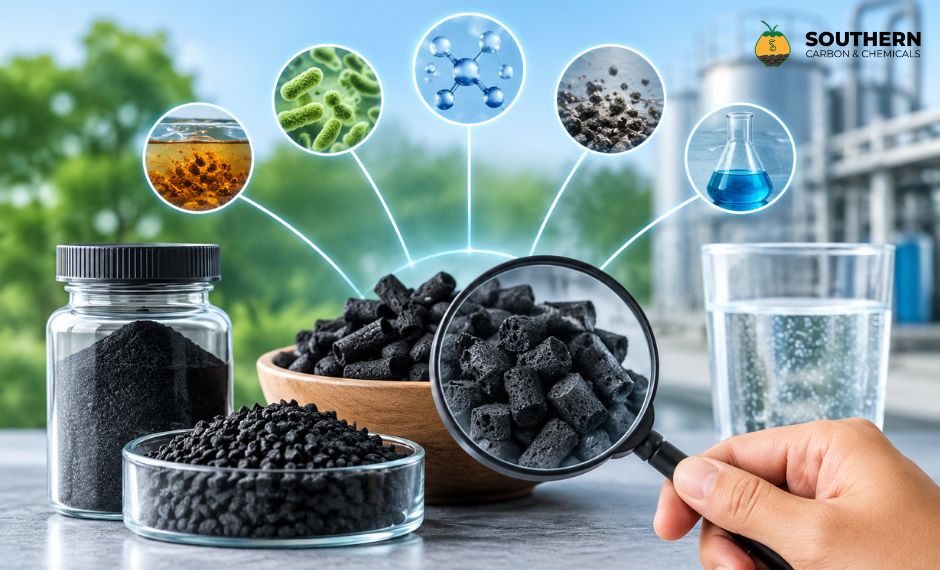
You can find the right type of activated carbon to remove your contaminant by first identifying what you need to remove and then finding a carbon with the right raw material, pore structure and form. If you have ever tried to source some activated carbon for water purification in India you will know that it can be quite frustrating. Two bags with the same wording on them, and one bag does a great job and the other hardly does anything. Activated carbon is really a family of materials, so different types will be good for removing different contaminants.
Know Your Contaminant
Before looking at any product, think about what you want to remove. This could be chlorine smell, yellowness, pesticides or solvent vapor from your factory line. Having a lab test result for your water or a list of the gases involved in the process will help with all your decisions down the road.
Activated carbons are adsorbents. Adsorbents work by attracting molecules of your contaminant onto the surface of the tiny pores. Finding the right pores is key.
Chlorine, Taste & Odour Removal
Typically, the best option is Coconut Shell Activated Carbon. This has a high percentage and a complex micropore structure that will attract chlorine, small organic molecules and bad taste/smell creating compounds. It is also very strong, so it will not break down easily within busy filters. Most drinking water and municipal projects start with this type.
Colour Removal & Larger Molecules
Wood based activated carbon has larger pores due to its more open structure. This can help with colour, tannins and larger organic molecules. These will not fit into the tight pores of the coconut shell carbon. This type is often used for colour removal and is often available as a powder.
Impregnated Carbon
Impregnated carbon has been treated with certain chemicals making it perfect for attracting contaminants that regular carbon cannot hold easily. This includes Hydrogen Sulphide, Ammonia, Mercury and Acid Gases. This is mainly used in air/gas applications. If you are looking to remove a specific gas/vapor then go for the Impregnated versions.
The Form of Carbon Matters
The form of carbon is also important. Granular carbons are used in filter beds/columns. Powdered carbon is dosed directly into the treatment tank. This is great for an occasional taste/smell issue. Pelletised carbon is commonly used within air/gas due to less resistance to the air flowing through.
Specification Sheet
A spec sheet can be quite daunting but look for these few important values:
- Iodine Value – Gives a general indication of the micropore capacity. The higher the value the more space for smaller molecules.
- Hardness – How strong the carbon is, so it can withstand the continuous process.
- Ash Content – How much non carbon is in the carbon. The lower the better.
- Particle Size – This affects the speed of the carbon. The smaller the particle size the quicker it will attract the contaminant.
- Moisture – You are paying for carbon not water. It alters the weight of the package, that is, you pay for 1kg, you get 950g.
The Limitations
This is something you should know about activated carbon early on. Activated carbon will not remove any significant amount of dissolved salts, Fluoride, Nitrate or Arsenic. These will require other methods of treatment like Reverse Osmosis, Ion Exchange or a specialist, dedicated media. A reputable supplier will tell you this clearly. Stay away from the suppliers who project activated carbon as an omnipotent substance for removing every impurity. Activated carbon has its own potential and limitations.
Choosing a Supplier
When comparing activated Carbon suppliers in India, look for a supplier that asks about your contaminant, runtime of your facility, restocking time, etc. This is usually a positive sign that indicates the expertise and experience of the supplier. A few tips:
- Provide them with your water test report or process information.
- Ask for a sample and carry out a small trial.
- Ask for lab results on the actual batch you will be receiving.
Southern Carbon have been manufacturing Activated Carbon in Kerala since 2001 using local coconut shells. We can handle bulk and small orders at the same time, every batch will be of the same quality that you require, that is, the 1st batch and 100th one will have the same numbers as results when tested from a lab. The team can provide you with coconut Shell, Wood Based, Pelletised & Impregnated variants of activated carbon. They will ask you about your contaminant first. If you are unsure which grade you need, just send across your requirements and they will help you find the right one.